Blog

Story Release: What the Darkness Asks in Return

Another story, pulled from my brain and splashed in a gory mess onto the page, has been released into the wild that is the internet. It’s one of the shorter ones I’ve written, and was based on a prompt on a writer’s forum, where we had to write a flash piece revolving around a teleporting door. A little over a year later with some edits, this is the result, published at Every Day Fiction.

It’s about portal to a rip in space-time, disguised as a door, that a 13 year-old boy uses to hide from his step-brother. Only, as you may guess from the title, it wants something back. I wanted to try writing it in the voice of a timid teenager, with minimalist, juvenile descriptions of the speculative element. It’s a meager 800 words, so do check it out.

It can be read over here.

Review: Iron Gold, by Pierce Brown

The fact that I finished this book a week ago and have still been unpacking my thoughts on it should be sufficient indication how much I enjoyed it.

I’m a die-hard fan of the first Red Rising trilogy, so I knew what to expect when diving into Pierce Brown’s latest, 600-page offering. I just wasn’t expecting Iron Gold to so wildly depart from the structure of the previous books, while still maintaining so much of the series’ identity, jacked up on Sevro’s steroids.

Never before has the world felt so alive and rich and full of wonders and danger. The world-building is a lot smarter this time; there’s no lengthy info-dumps; there’s droplets of exposition and hints of how this world and it’s microsocieties function, from the scarcity-minded people on the Rim who’s decorative tastes and methods of torture match their lifestyle aesthetics, to the political arenas on Luna taken directly from democratic councils in ancient Greece, to the cyberpunk-esque superstructures and the people that inhabit them. The world(s) slowly build in your mind until there’s a very vivid and very personal universe coming alive on page. It commands attention, and it deserves it.9780425285916

And just of commanding of attention are the characters. Going for four PoVs was the correct choice, although some were much more interesting than others. Ephraim’s guff, raw attitude could have been pulled straight from Blade Runner, Lysander’s complex and nuanced storyline and characterization made me hate how much I loved him, Darrow is as delightfully rash and stubborn as ever, and Lyria’s cocky attitude brings a new set of eyes to the world. Lyria’s PoV was decidedly the weakest, and her character arc felt a little too sudden. And if there’s any fault I can find in this book, it’s that Darrow is more absent from the on-screen narrative than he should be. Darrow’s the heart and soul of this world, after all, so it was disappointing not to see him and the Howlers (and Sevro, the little devil) taking a more on-screen role. I’d have gladly swapped a good chunk of Lyria’s PoV for his.

But in saying that, each of the characters are phenomenally sketched, their emotions and feelings so sharply detailed that it’s impossible not to care about them ever so much. The events of any given narrative cannot emotionally support itself unless it has the central characters and their feelings, reactions and social views providing the backbone. And in Iron Gold’s case, each of these characters’ reactions to the unfolding events is a quiet revelation. Their feelings are messy and rash and motivated by spur of the moment decisions (which they may or may not soon regret), filled with heart-break and rage, and it’s wonderful to embroil yourself in the middle of this chaos. I felt like I was with them every step of the way, right until the bitter end that felt me hating how much I love Pierce Brown, but also want to scream at him.

This book is nothing less than a phantasmagorical mash-up of science-fictional exuberance jacked-up to the hilt. There’s so much richness and goodness bursting out of the seams of the characters, technologies, planets and cities of the world it threatens to spill over. Science-fiction is said to be the genre of ideas, and never has it been more true here. The action is rich as ever, the politics as cuthroat as ever, the world several shades darker, the almost endless cast of characters play their roles as productions of their culture and upbringing to levels so theatrical it’s almost Shakespearean. Brown’s velvety prose is so rich and jam-packed with detail and tiny literary gems it’s like he didn’t think he’d get the chance to ever write another book. Even on its own, every page is a delightful morsel. As a whole, this book is a dessert masterpiece.

Pierce Brown has absolutely out-done himself in almost every way and should be given a round of applause for producing something so stellar it reaches meteorological greatness. It might be too early to call it book of the year, but I’m going to do it anyway.

The wait for Dark Age will be unbearable.

2017: A Year in Review and taking risks (and eligibility stuff)

So. Another year’s whisked by. A strange year, to be sure. But also a busy and productive one, both in and out of writing.

I’ll waffle on about the year as a whole, before I list all my publications at the bottom for award eligibility and reading sources (this is what all the cool kids are doing, apparently).

Novels:

It was last year, way back in 2016, that I  really kicked novel writing into gear, having penned The Rogue Galaxy. I swore, that if nothing else, I’d get an agent. And on May 31 of 2017, the day I turned 22, that happened. The wonderful and endlessly patient John Jarrold offered me literary representation (and by extension, my film/TV rights got rep’d by The Gotham Group). After tirelessly chasing after agents for years and failing at every turn, getting The Call and just knowing that I’m one major step closer to having a novel published was my highlight of the year, no contest. The process of writing is plagued with self-doubt, self-loathing and way too many coffees, and having the guy who edited Robert Jordan, Iain M. Banks and Guy Gavriel Kay tell me that I wrote a “great book” and take a gamble on representing me (an offer he only makes to four people a year) works magic for validating your position as a writer.

I went through edits for Rogue – my first time doing agent edits – and it’s been on editors desks for a good few months now. This post would be very different if I’d gotten good news, so it’s no secret that it hasn’t sold. No book deal. Yet. But come 2018, that could change. And I truly hope it does. My gut feeling is that next year is going to be the year I achieve what I’ve really always wanted ever since I started putting words on a blank page.

I finished my next novel, Stormblood, my 1st person-narrated The Wire/Mass Effect mash-up, at 113k (since become 120k). I technically started it in December 2016, but I was so occupied with Rogue that it got put on the back-burner. It’s my favourite thing I’ve written so far, and the first time I think I’ve really “broken out” as a writer, but more on that below. As of writing, I’ve finished agent edits on it and will sending it to John for one final look in January. I’ve also reached 50k in a new novel, this one a heist narrative set in a dystopian world. My agent likes it so far, and I’m excited to keep working on it in the new year.

So that’s three novels worked on in 2017, and written two of them for a total of almost 200k. Which I’m very, very happy with.


Short Fiction/Other Writing:

I had an excellent year for short fiction, considering that novels have remained my priority, doubly so since I got an agent. While I haven’t sold everything and haven’t hit all the magazines I wanted, but I’m happy with what I’ve got, and I’m very happy with the audiences I’ve reached. Here’s my work, and my thoughts on them.

When there’s Only Dust Left
Nature, 950 words

A dark story about AIs being put into dust motes and worming into the heads of enemy soldiers to torment them and warp reality.

House of Dolls
Tales to Terrify, 2600 words (audio)

My debut publication with this podcast about two people who find a series of mannequins locked in a basement. It’s also one of my favourites, but you be the judge of that.

The Human I Never Was
EveryDayFiction, 830 words

Another flash piece about the merging of man and machine, overlaid with a cynical, in-your-face voice. I’ve been trying to sell this one for a while now. It’s a divisive story, with over three dozen comments arguing about it’s merit and what I was really trying to do with it. And that’s exactly what I want. A strong reaction is better than no reaction at all, (there’s something truly special about being a fly on the wall, listening to folks analyse your work) and since the majority of people did like it, I’m very content.

Ark of Bones
StarShipSofa, 6700 words

I’ve been trying to sell this District 9-esque story about human and alien segregation for ages, and I’m very happy where with it ended up. My favourite story of the year is about friendship, brotherhood, the cost of oppression, and is rendered in audio beautifully by Mikael Naramore. I often don’t like listening to my own work narrated, but this is the best exception. I’ve gotten wonderful feedback from folks who’ve tuned into it. And again, knowing that so many people are hearing your characters and your worlds narrated in their iPhones and cars is awesome. I love this story,  so it’s great seeing how it’s turned out. Also: it’s been translated into Chinese by Science-Fiction World and will be releasing to an even bigger audience in a few days.

The dataSultan of Streets and Stars
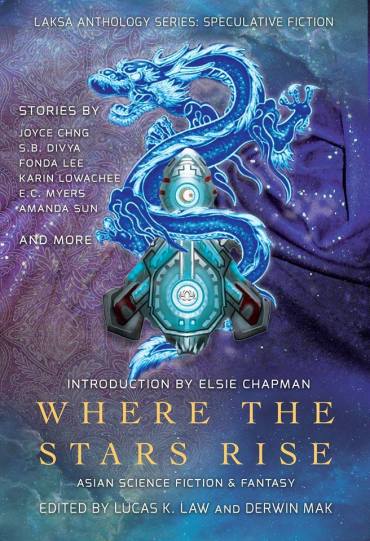
Where the Stars Rise: Asian SF, 7100 words

My other favourite story of the year is also the only one not available online for free, but can be picked up from any online retailer (and here’s why you should). It’s got espionage, Arab gangsters, AIs turned djinn, and a snarky protagonist in future Istanbul, and was an absolute blast to write. It’s one of those stories I took a risk on, and I’m very happy with the end result. It’s been pretty well received, every second review on Goodreads mentions it in a positive way, with one reviewer rating the anthology as a whole with “4 out of 5 djinn” (bingo square). The anthology seems to be doing well, and I hope the reviews and sales continue to pour in. If you want to read an excerpt, you can do that here.

Not a huge amount of stories, but I’m happy with them, and happy with the ones that have been reprinted. Look out for future, upcoming work in Abyss & Apex, Tales to Terrify, Shades Within Us, and a translation in China’s SFW.

And as always, if you have any thoughts about these stories, good or bad, do get in touch. Hearing from readers is the best part about being a writer, and we really do care about what you have to say, as long as it’s respectful.

Life:

I’ve really stabilized my place in life. I’ve fixed up my house, cemented my weekly schedule, and started broadening out to a wider, but tighter circle of friends that have made me realise what I was missing out on before. I managed two overseas trips, one to Finland where I had an awesome experience at WorldCon (which you can read about here). I’ve started to lose weight, starting cooking again, really settled into my day job, and started exploring a bunch of new things I’ve always wanted to do, even if it’s going out on nights when I’d usually stay at home or using my local beach more. I’m an adventurous person, but like everyone I settle into a rut far too easily, and I don’t like budging out of it. Now that I’m making an effort to do just that…yeah, it’s worth the effort.IMG_5564
Last year was the start of me finding my own feet in life, but 2017 is really where it went into gear and I started living for myself, and started realising the full extent of my options. It’s scary, but it’s also liberating. I’ll likely be packing my bags and heading to Thailand for a week or two in the new year, something I never considered doing by myself a couple of years back.

There’s always room for improvement, and I have a few things I want to remedy (improving my patience, for one), but I’m determined to get there.


Taking Risks:

I lied when I said that Stormblood was the first novel where I broke out of my rut and wrote whatever the hell I wanted to. I did that before, but it was Stormblood where I knew I was going to take every plunge.

All writers knows that when we put something on the page, we’re giving a piece of ourselves away. We’re revealing to other people what we’re interested in, what makes us tick, the things we want to express, and piece of who we are. It’s cliched, but it’s true. And when you put yourself on the page, you’re opening a peephole into your brain and letting other people know how it works. How you work. How you feel.

So it’s understandable that you might want to hold some of that back.

Which is why, sometimes, I’ve held myself back. From writing first-person, from writing snarky, voice-driven stuff. From putting my characters through certain things, giving them certain histories and traumas. From channeling certain emotional experiences and sentimental values. From writing certain kinds of worlds, even kinds of emotional arcs. There’s always been there, but I’ve always held back. I’ve always stopped myself from “going there”. Not only because I wasn’t sure whether or not I could do it, but whether I should do it. If I was prepared to give those parts of me away. If I was ready for other people, including my family and close friends, read it.

But writing isn’t worth doing unless you’re writing exactly what you want to write. Not what sells, not what social media dogpile of the week says you should be. What you want to write.

So with Stormblood, that’s what I did. I created a post-war world that was both gritty and exuberant, savage and wondrous. Filled with machines and cultures and technologies that have been burning in my head for years. But at the center of it, I wrote a bi-racial, two-metre tall guy in first-person, a guy who’s been through all kinds of personal hells and traumas, and lived to tell them. I didn’t shy away from them, and I didn’t shy away from giving him a strong voice with a warped sense of humour not unlike my own. But I also didn’t shy away from making him an emotional and conflicted human being. He’s sculpted by his past and his relationship with his brother, reflects on how he feels about authority, his siblings and his friends, and how they’ve emotionally shaped him into the man he is. I explored some stuff I wouldn’t dare meddle with two years ago, and put him through certain torments I didn’t think I could ever pull off successfully. Basically: I put my heart on the page.

Even now, is this isn’t easy for me to admit.

It’s not like I didn’t already weave in ideas and themes and narrative elements that are special to me into my work, they’re in everything I write. But this was the first time that the tap’s on full blast. That I sat down to write a first-person narrator that embodied so much of what’s important to me, his story infused with peoples and concepts and ideas tapped directly into things I love and stories I want to tell.

I mentioned earlier that Stormblood is my favourite thing I’ve ever written. This is why. The pay-off was truly and utterly worth it. My agent and beta readers all agree it’s my best project yet. That it’s got a confidence, a genuine-ness about it. I’m already getting comments from my family and friends that the main character is an insight into me as a person. Which is its own certain kind of reward. But better than that: it feels authentic.

Doing this has forever shaped the way I write and the stories I want to tell and the way I want to tell them. I’ll be taking those risks, writing those emotional highs and lows. Putting bits of myself into my characters, even if it’s sometimes more than I’m comfortable with. Forcing them through certain experiences and traumas that I’m afraid to write, because I know the pay-off will be grand, and because it’ll be exactly what I want to write. Because, really, otherwise it’s pointless.

So if you are afraid to reveal bit about yourself, or you desperately want to write something but are unsure of the end result, or just can’t muster up the courage to tell the story that only you can tell, do it anyway. Because that’s what I’ll be doing in 2018, and I will not settle for less. And I hope you won’t, either.

Writing Update: Stormblood Edits

At the tail end of the year, my good good agent John Jarrold has sent me edits for my next book, Stormblood. It’s The Wire meets Mass Effect set on an asteroid that’s comprised of a hundred cities stacked on top of each other. Contains first-person snark, alien drugs, drug culture, religious cults, armor, gangs, neon-dunked streets,, food porn, and booze. Lots and lots of booze.

I’ve been tackling the edits for a few weeks now, they’re going pretty smoothly. It’s been slowly climbing in word count to where it sits at a solid 120k, 15k longer than The Rogue Galaxy, but John told me not to worry, since 140k is not unusual for a debut novelist, especially in the UK.

So I’m letting my legs stretch a little, letting the slow moments between characters linger, letting them shoot the breeze and grow on-screen rather than rushing because I’ve got to keep the pace up (nailing this balance down is no easy feat). It’s cathartic to keep refining and discovering things about your world and characters and know that you’ve really nailed a scene. It’s always my favourite part of the writing process, where you’re giving each chapter the last few polishes and finally see the gems and realise how pretty they are, to con a cliche. In earlier drafts, I knew I was onto something, but it was too broad, the waters too muddy for me to sharpen it to a fine point. Now that I’ve got the shape of the narrative burned into my head, it’s easier to take that paragraph, or that chunk of text and realise what it’s doing in context, and improve upon it until I’ve got exactly what I want on the page. I go over each chapter like this, honing the emotions, the narrative development, the scenery, until it’s as good as I think I can make it. It’s so, so easy to overstep and turn a quiet, sedated moment into a melodrama of sentimental monologues that are shamelessly trying to exploit sympathy from the reader. The line’s harder to walk than you’d think. I’ll forever believe that characters are the true heart of any narrative, and I want their emotions and desires and conflicts to be on-point as possible. So I’m going through the book and trying to make that happen.

It’s not perfect, but I love this book and almost everything about it, and I hope it sees the light of day at point. But if it doesn’t, then I’m still happy to have written it. There’s a lot of personal things in this book, baked into the characters, story and world, and putting them on the page has taught me a boldness that I’m not sure I had prior to writing this. I wrote what I wanted, but there were some things I deliberately avoided because I wasn’t sure how they’d be received, and if I’d want folks close to me reading it. But I went with my gut and spun out a first-person narrator who wasn’t afraid to be forthcoming out his deep, personal traumas, who said what he was thinking and got some pretty messed up things inflicted on him as a result. It even prompted my agent to comment on it.

drnlsx5v4aazvib

He does it to himself, I swear!

Anyway, my current round of edits will continue to consist of refining each scene, tightening up the dialogue and making sure the world-building is in shape and the character arcs are on a smooth trajectory that’s isn’t too blatantly going through the motions of a narrative path. The next round will be more focused on the prose-level. I edit my prose as I go, but this time I’ll be putting the final touches on the work on a sentence level. Some don’t bother with this, but to me, language and choice of words is important, and if I can look fancier by replacing lobby with atrium or blue with cerulean, I will, dammit!

I’ll probably polish off edits this week, and turn it in early next year. Me and John are going to discuss what to do with it. I’ll be posting a yearly round-up soon, so look out for that, and have a great holiday.

Book Release: Where the Stars Rise and Asian Science-fiction

It’s not been a bad year, writing wise, but having so much on means I get my attention split between projects. But even so, I’ve always been focused on this one project ever since I was asked to contribute towards it. And almost two years later, it’s out!

Where The Stars Rise: Asian Science Fiction & Fantasy is exactly what it sounds like: an anthology that focuses on Asian science-fiction and fantasy, exploring Asian cultures, themes, language, histories and futures. Being from a background Lebanese background, not usually a culture typically associated with Asia like Japan or China, I went for I knew everyone else wouldn’t be writing. So I wrote a spacepunk story set in Turkey, because I could.17352543_10155107326431575_1699043594855734950_n

The dataSultan of Streets and Stars is about Bohdi, young programmer of AIs (dubbed djinn) who’s had to skip Earth when a nasty accident resulting in the death of dozens puts rich-as-hell Arab gangsters on his tail, believing him responsible. Only, Mr. Bohdi is in debt to a dangerous alien bounty hunter, who wants the djinn for himself. And things get…messy.

It was a pleasure to combine cutting-edge technology and cool ideas with Middle-Eastern culture and history. Computer viruses are named are monsters from Islamic mythology, starships are fashioned like Phoenician ships, and tech-centres are constructed like Ottoman buildings. And food. Lots of baklava and lokum. When I build a world, I want it to inhabit every sensibility and every character aspect, and I think I achieved that here.

There’s so few good depictions of Asian cultures, and especially Middle-Eastern cultures, so I’m very proud of this story, and happy it’s in this anthology. And I’m even happier it’s doing so, so well. Here’s some reviews:

“. . . this collection is essential for anyone interested in the diverse and engaging possibilities of fantasy and science fiction.” — Booklist (American Library Association)

“. . . this fascinating collection addresses issues of immigration, dual cultures, and ethnic issues through genre devices such as ghosts, steampunk robots, and planetary exploration. Sf readers looking to discover new voices will enjoy this volume that reflects the eclecticism of Asian culture.” — Library Journal

“This anthology was good, with the majority of the stories being either good or very good page-turners.” — Tangent

And then it gets even better, because two of my favourite authors provided blurbs.

“A wealth of stories running the gamut from poignant to mind-blowing, rewarding journeys both faraway and familiar.”
— Aliette de Bodard, Nebula Award-winning author of the Dominion of the Fallen saga

Where the Stars Rise is a hell of a lot of fun. Great writers, magnificent storytelling, and worlds I wanted to spend a lot more time in—no matter how dangerous they were. I had a blast reading it.” — Rob Boffard, author of the Outer Earth series (Tracer, Zero-G, Impact)

And then there’s some select quotes from Bloggers and Goodreads reviews:


The complexities of the stories and the characters and the stories will delight readers, but they will also elicit a reaction all too familiar to book lovers everywhere: the stories will leave readers wanting much, much more. I recommend Where the Stars Rise and also encourage this new subset of science fiction and fantasy. – Ekta R. Garg, from The Write Edge


There are historicals, futuristic, space settings, fantasies, Sci-Fi, with male and female protagonists of all ages. I learned about different counties and times and events. I traveled to the moon and other planets. Some stories are funny, some are sad, some have happy endings and others were bittersweet but I’d be willing to bet that readers with even a passing interest in these genres would find a few to appeal and many to enjoy. Overall, a B+- Dear Author Reviews


There are some truly standout pieces; Memoriam by Priya Sridhar, Back to Myan by Regina Kanyu Wang, and The dataSultan of Streets and Stars, by Jeremy Szal were amazing for me. There are many more well written stories included, but just these three alone are worth the price of the anthology.  – NonStop Reader

So people are very much enjoying this anthology, and you will, too. It’s important to boost diverse voices and to support projects that cover international cultures and worlds that are left outside of the mainstream. If you’re interested in Asian cultures, this one is essential.

The website and full retailer list is here. But you can grab it from Bookdepository for free delivery worldwide. Or ask your bookstore to order it in. And do remember to leave a review on Goodreads and Amazon. It helps. A lot. More than you think.


What I’m Reading, and my conversion (not quite) to Audible

I’ve been reading quite a lot lately. Or rather, listening a lot, since I got Audible and have been tearing through books on the day job. I’d never be able to get through 3 books a week like this. So far I’ve gone through The Quantum Thief (loved it), The Ocean At The End of the Lane (enjoyed it very much) and I’m halfway through Andy Weir’s Artemis (which is…okay so far). There’s so many books I want to get through but don’t have the time to read at home, so I’m loving this.

Other books I’ve read in print have been Broken Monsters, (adored this dark, dark book so so much) and a re-read of the Red Rising series (quite possibly my favourite series ever). I’ve suffered through too many awful and boring reads (looking at you, Provenance) to sit through books I don’t enjoy.

But now I’ve got Audible, and am being smarter about checking out books before I buy, (yeah, the cool kids use the library) I’m tearing through these books. And I always leave reviews on Goodreads and Amazon to support the authors and publishers (and you should, too).

Ark of Bones now available! In audio!

https://embed.acast.com/starshipsofa/starshipsofano509jeremyszal

A very, very belated post: but my short story “Ark of Bones” is now available in audio over at StarShipSofa in episode 509. It’s narrated by the wonderful Mikael Naramore, who’s narrated audiobooks by Clive Barker, Nora Roberts, Wesley Chu, and other writers much more talented than me.

His buttery man vocals bring the story to life in ways that put a stupid grin on my face, and I usually can’t listen to audio adaptations of my work. But this one, I’m very much able to hear his rendition of my characters again and again.

This is the short-story version of the YA SF novel that almost got an agent, but didn’t. I was cut up about it, but not enough that I was done with the world. It wouldn’t leave my brain, even a year after the final rejections came through. So I decided to write a shorter, tighter version (and one with a much better endings, methinks). Humans have occupied over the planet of Arkaeyus and segregated the native aliens into a filthy refugee camp that’s getting smaller and smaller as the paramilitary slowly eat away at their rights. This story focuses on a human and his best mate, who happens to be one of these aliens and their investigation as more of these aliens start to disappear.

It’s a little strange, having a story appear at a podcast I edit. I’m very aware of how prevalent nepotism is in this industry. Tony read one of my stories a few months back in the anthology he published, and was interested in putting it on the show. But the rights were taken up, and he asked if I had anything else. I offered up another story on the condition that he decide whether or not it was good enough. He thought it was. I was a hesitant (againn, nepotism), but since this was a solicited piece, and I wasn’t the one making the decision whether it’d run or not, I decided to go through with it.

So. It’s now finally available to stream into your earholes worldwide. It’s one of my favourite stories, and it went through multiple drafts before I even started polishing it.

I first started building this world it during university classes back in 2013, so seeing it all finally come to life in audio is is something pretty special. 🙂


“Oh, you’re THAT Jeremy.” WorldCon75 and Realising You’re a Writer


There’s little moments in every writer’s life, when he or she realises something’s changed. You’ve upgraded. When I sell a story to a good market, when I’ve nailed a third act in a novel, or even I signed with my agent. I recognized that I’d leveled up; hit a new milestone.

But there was nothing little about my experience at WorldCon 75, where it occurred to me, perhaps for the first time, that I am a writer.

See, having never gone to a con of any sorts before, and being in the almost non-existent literary scene in Australia, I’ve only ever met authors briefly at rare book signings. And that’s assuming you have more than twenty seconds to blurt something out before you’re moved along and they’re seeing to the next person standing in line behind you.IMG_5627

So I don’t think I was ready to make my con debut WorldCon, and see everyone. My literary heroes, people I’ve been reading since I was ten years old, creators who’ve inspired me, annoyed me, entertained me, gave me food for thought: all in one place at once. In panels, in the cafes, in the bar, everywhere.

And thing I was especially not ready for: being among them. After seeing my name on the program, alongside the best and brightest of the genre, I knew I wasn’t here as a passive observer. I was here as a writer among other writers.

I hadn’t just leveled up: I’d reached a whole new level of its own.

*

Five minutes in: I’d ran into the wonderful Aliette de Bodard, who gave me a hug and said how cool it was to meet me. I didn’t have time to tell her the exact thing before she mentioned how much she liked my story in the anthology she blurbed: Where The Stars Rise. It’s one thing to write a story you love. It’s another to have someone you very much admire tell you to your face it provided them with reading pleasure.

Commence me wandering the corridors, picking out writers. Ken Liu. Ted Chiang, Daryl Gregory, Thomas Olde Hevult sipping coffee in the cafe. Robert Silverberg in the exhibit halls, Gay and Joe Haldeman in the auditorium. George R. R. Martin, casually rocking up in the main foyer (and yes, I got a photo). Ian McDonald, Ian Whates, Michael Swamnick knocking back G&T at the bar. People I’ve only interacted with over social media, people I’ve been reading for years. Now I get to see and meet them in person.

Except I’m not just meeting them. They’re meeting me.

Again: at book signings, you’re not an individual. You’re just another person in a line who presents the lofty author with a paper for them to scribble on. Then that’s it: they’re seeing the next person and you’re already forgotten.

Here, I got to sit down with Ian McDonald and talk to the man, level to level. Not as a slack-jawed idolatric fanboy to whom the concept of sex is frightening, but as another nerd who also writes about robots, far-future gang wars and exuberant cultures. I got to catch the train with Ken Liu and hear him tell me he enjoyed my essay in PoC Destroy SF. I got to tell George R. R. Martin I was from StarShipSofa (“Oh, the podcast, right?” I remember him saying. He also mispronounced my surname as “Sazzle, but that’s another story) and see him nod as he realised I was the guy who reprinted his undiscovered story The Men of Greywater Station and put it online for the first time. It was a down to earth, man-to-man experience where I was a fellow writer/editor who knew a thing or two about the craft. And all these Very Prestigious Writers actually listened to me. I wasn’t just another twenty-two year-old bloke from Down Under: I’d had work published that was noteworthy. I could sit down at the table with the best and brightest and contribute to the conversation.20819638_10155896869333072_8219742842188189269_o

I remember walking into the foyer and meeting Ted Chiang, the Ted Chiang. Admist our conversation about “smarter” SF cinema, I never got the impression I was speaking with the genius who birthed Arrival, but a quiet, intelligent man who was genuinely interested in what I had to say. Hell, having drinks with Ian McDonald for about seven hours (he bought us all 81 Euro wine) and having him introduce me to Ian Watson and Pat Cadigan as “The Lord of StarShipSofa” put the stupidest grin on my face. I was no longer an unknown outsider: I was welcomed into this circle of mad geniuses as not only a writer, but as a person. After years of struggling to get noticed and while watching these same authors get book and film deals, talking to them as other human beings and finding that they care is probably the biggest career boost I’ve had in a long time.

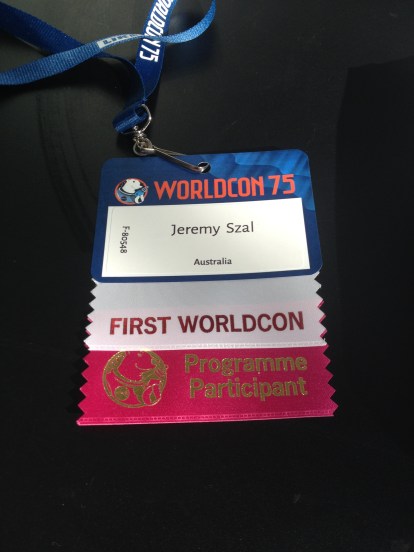
But perhaps the biggest surprise was: everyone, and I do mean everyone, I spoke to was aware of StarShipSofa in some capacity. All I had to do was mention the show and the connection was made: they knew who I was. I’d talked to Mary Robinette Kowal for ten minutes straight before she saw my badge and exclaimed “oh, you’re that Jeremy.” Even outside of meeting authors and narrators I’d reprinted and worked with, I had people who recognized my name and said how much they loved the podcast. I think more people were surprised that I didn’t know how popular the show was. I knew people tuned in, but I couldn’t imagine this many people, or how highly they regarded it. To have people express what my weekly efforts of producing good stories means to them is incredibly humbling.

This is doubly true for my own writing. Unless people email in, you don’t know if anyone’s reading your stuff, let alone enjoying it. Here, I’d have people casually bring up my work in conversations. Stop me in the corridor to say they loved a piece I’d written. That they found the certain story to really hit home. They’d name the stories I’d written, tell me their favourite characters, their favourite moments. They compared themes they’d found across my stories (some more valid than others). I was told they loved my “icky flavour if sci-fi body horror”, which is apparently now my sub-genre. I was congratulated on acquiring an agent, and was told by many, many people that I’d landed a solid one. That my novel sounded “super cool” and they couldn’t wait to get their hands on it.IMG_5715

And I’m still reeling from the fact that people even read my stuff.

My work has left an impact on people. My long hours creating worlds and characters I love actually matters to people. The stories I struggled with, thinking no one is going to read this shit has people I admire approaching me to dole out praise. As a writer, you want for nothing more. It puts a certain responsibility on your shoulders to continue doing good work, because there are people out there paying attention to me as a creator.

Somewhere in the midst of all this: it told me that I am an author. People read, love, respect my work. And there’s no dialing down from that. Even if I were to never write another story, I will still be an author who is read and recognized. I won’t ever be able to go a con or hang out in a writer’s group be a nobody: there will be someone who knows me or has heard of me.

Which is equal parts inspiring as it is unnerving.

*

Cons can be exhausting. Being in fandom can be exhausting. Being a writer in fandom can be very exhausting.IMG_5707

Meeting your readers and admirers is welcoming. But if you hear it so many times in such a short period, it loses its charm. Recognizing people in every corridor, meeting someone you know almost every fifteen minutes, running back and forth to attend a lunch or meeting or panel or whatever for 16 hours a day? It wears you out.

I was scheduled to appear on two panels at WorldCon 75. Having never done panels before, I had no clue what to expect from talking to a room full of strangers about my so-called expert opinion about writing. Both panels went very well; the second one especially, where our room (see photo) was fully packed out. The discussion was fantastic, the questions were great, and people cared more about and our approach to our work. Hell, a Swedish blogger took notes on everything we’d said. I only wished I was on more of these panels.IMG_5711

I’d made plans with my fellow panellists after the event. But when we were done, I got swarmed. People wanted to talk more. That story of mine: where did that get published? That market I mentioned: how did I get published there? When could they find my work? What was my website, again? How could they submit to StarShipSofa? How did I get my agent? Could I perhaps mention them to my agent? What was my book about? How long did it take to write my book? Did I have any advice?

I’m trying to answer the best I can, while still looking for my friends who are disappearing down the narrow corridor, while answering my phone, while fighting against the surge of crowds, while still thinking that I haven’t eaten in seven hours.

For about ten minutes, I think I got a glimpse of what being “famous” is like. It’s not pretty.

Coupled with the built up strain of Being an Author in Fandom for 16 hours a day, everything crashed on top of me and I needed a quiet corner to hide in. I just couldn’t do people anymore. I loved mingling with my fellow writers. But I couldn’t take it anymore.

Now, anxiety ain’t ever going to be a problem I’ll have to deal with. I’m outgoing, I’m unserved, I’m an intense individual. Ask anyone who knows me. I’ve got skin thicker than a dragon. I’m probably in the top 5% tier of “can tolerable any bullshIMG_5482it” people.

And day three floored me.

Now that I’ve been on the other side of the signing table as it were, I’ve got a newfound respect for famous authors, actors, celebrities. I simply don’t know how they deal with the attention. How do you compartmentalize having someone want something from you at every corner? I’m nobody, just a guy who gets a few minutes of attention at a sci-fi gathering. Anytime, I could walk out the doors and no one would bother me. No one would demand a photo from me. No one would stalk me down the hallways, hoping to get a few minutes of my time. George R. R. Martin? Neil Gaiman? Not so much.

How do these guys manage to go on book tour without blowing their brains out?

So yeah. Being in the spotlight, even briefly, has a dark side. As humbling and amazing and ego-boosting it is to have people want to hear your advice or gush about your work, everyone has their limits. And trudging back to my hotel at 2pm with a pulsing headache, I know I reached mine.

*

I’m back in at work in Australia now. Back to being another average guy on a beach suburb. I take my laptop to the cafes to write, because that’s the majority of what being a writer means: writing. The cons, the panels, meeting the people who gush about your work: that’s all a bonus.

But after attending WorldCon, I know that there’s people out there who are taking notice of my work. People who remember me. People who are waiting for my next story, and are hoping they get to read my novel. I’m a recognized name in the field, and my literary heroes are aware of me as both a writer and editor. I sat on the same programme with George R. R. Martin, Robert Silverberg and Cixin Liu. I’m still getting fanmail for my panels and having photos of me get tagged on social media.

IMG_5564

And I’m sitting here, still trying to figure out how it all happened.

WorldCon changed my outlook as a writer, and made me feel like a real, genuine writer for the first time. It’s made my long hours doing something I love so much more rewarding. It was the family reunion I never knew I had. A really messed up, half-mad family, but a family nonetheless. And I’m already counting down the days until the next one.

So long, and thanks for all the lutefisk.

Create a free website or blog at WordPress.com.

Up ↑