Yearly wrap up: 2024 edition

2024 wasn’t the worst of years. Nor was it the best of years.

As many of you know, in late 2023 I impaled myself with a nailgun in my left hand, missing the bone by less than a millimeter. If it had connected, I’d have shattered the digit. It did not connect.

But that didn’t mean I got away scot free. Oh, no. The incident gave me complex pain regional syndrome, nerve damage and ulnar nerve damage, which led to a slew of pain management therapies, new medications, weekly doctor visits, constant appointments, required exercises, and dealing with the red tape of it all, which triggered further mental health issues and gave rise to other health issues that were simmering away beneath the surface.

I don’t like to talk about this much, because I live it every week, and I really don’t want to be one of those Professional Pain Sufferers, as my GP calls them, who can only talk about their own agonies. But it’s safe to say that 2024 was a very stop-start year for me, and no one wants to spend the last year of their 20s dealing with a critical hand injury, not knowing how much longer it’ll continue on for.

I’ve made no secret of the fact that I’ve been going through some rough patches, mentally, due to the stresses of publishing, and how the writing has suffered as a consequence. As you can imagine, the injury has not helped. I wasn’t able to publish Wolfskin in 2024 like I wanted, and so sometimes it’s felt like publishing has been moving on without me, like I’ve fallen overboard on a ship and I’m stuck floating in the water, watching the ship move further away from me, leaving me behind until it’s an inscrutable speck on the horizon.

To watch authors who debuted after you get proofs and cover art and special edition deals for their next series while you’re still stuck on the one feels extremely disheartening, especially when compounded with a whirlwind of other doubts and stresses (is anyone even reading my stuff? Does anyone care? What’s the point of this?). Doubly so when all of your peers keep talking about how much fun writing is and how another day at the keyboard is another day doing the best job ever, and you feel like setting your computer and your face on fire. There’s been times when I’ve seriously considered leaving publishing for good, unable to take the anxiety and pressure (and anger) that stems from the meatgrinder of the publishing industry and how it feels like it poisons the passion you have for your creative work.

This isn’t a “woe is me” post. But I do believe in honesty, both on a professional and personal level, and this is the narrative I’m telling.

But I won’t be quitting of course. Because I’m a writer. And this is what I do. And there isn’t a single person on earth or heaven that’ll stop me. (Where do you think Vakov gets his stubborn streak from?)

While those feelings have not always disappeared, 2024 has seen them become far less intense and overwhelming, especially towards the latter months. Things have been better. Much better. Sometimes, all you need to do is to take a step back, stay in the shade, reframe your thinking, and then step forward again. Attitude and positivity matters. A lot. Fighting off the Raging Demon Voices isn’t always easy, but the less space I give them, the smaller they get.

And because of all that, I’ve had a very, very productive year. Which brings us to….

Publishing

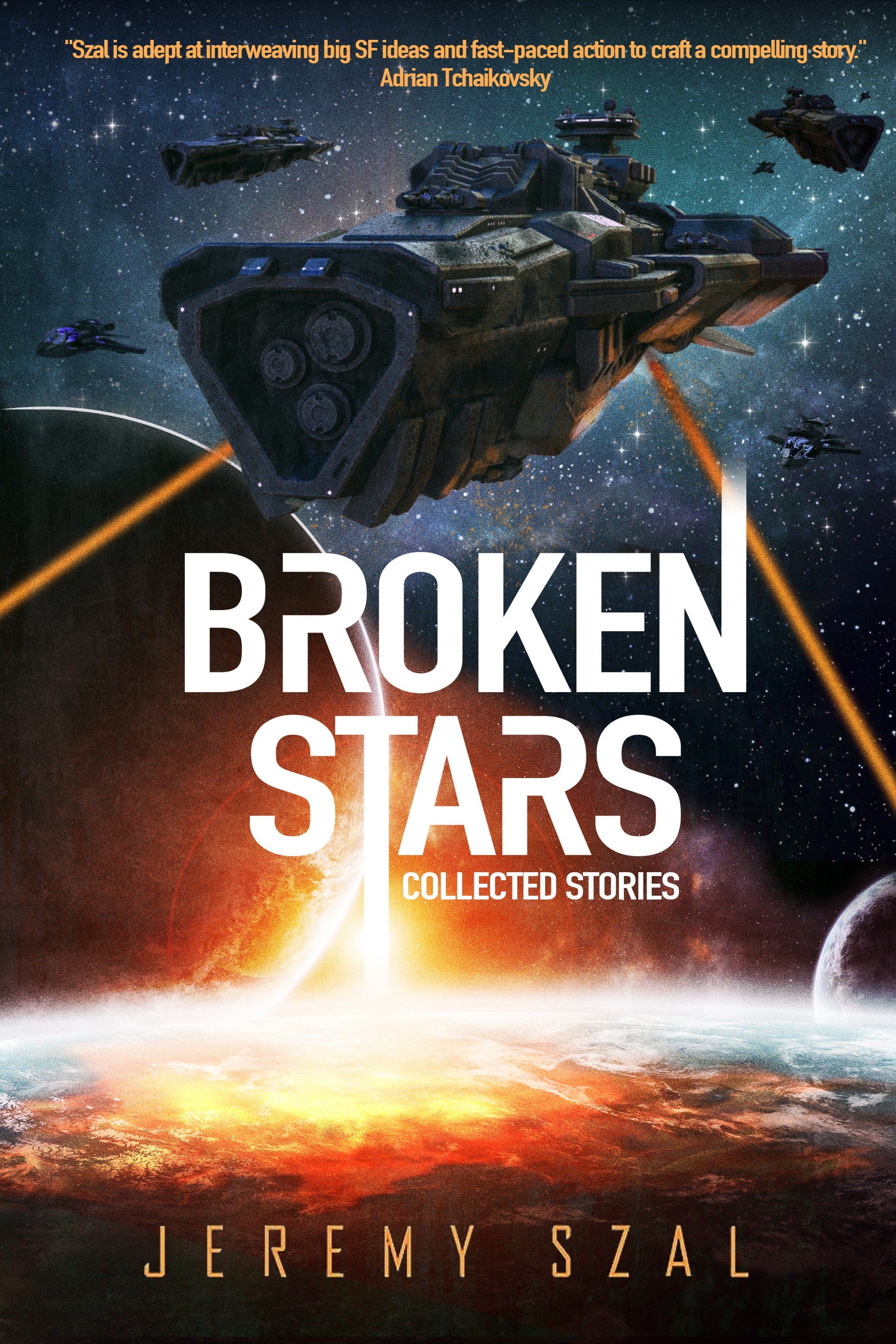
The only project I published in 2024 was independently publishing Broken Stars in Nov 2024. All these stories were previously published except two, but I still consider the entire collection to be an original publication. It’s picked up some really solid reviews, and has been stocked in a few local bookstores and libraries, which always makes me happy.

Interestingly, releasing a new book means that your previous titles get a fresh wave of attention. I’ve had a few people say that they wanted to check out my traditionally published books because of Broken Stars being released. I mainly put Broken Stars out so I could keep my name in the spotlight between major releases, and to dust off some of my older works and give them a bit of new life, so I’m pleased to see that it’s all going to plan.
The majority of my year has seen me work on a new project. I don’t want to say too much about it, only that it’s science-fantasy and is set some 20,000 years in the future. It’s somewhat similar to my other books, but it’s also . . . not. It’s more epic. More poetic, grandiose. But fear not, it’s still very much me, and I’m hoping that it’ll be the next thing that I publish. I’ve got about 140,000 words down, not including material that I’ve already cut or reworked. I hoped to have it finished, by the end of this year, but Wolfskin edits have derailed those plans.

And because I don’t have enough on my plate, I’m working on another project. A secondary world fantasy with a female protagonist and some very nonhuman characters, on an epic quest. I won’t say more than that.

As for Wolfskin, I’m doing another pass on it as we speak, with the goal of delivering it to my editor in January. It’s been interesting to see how I’ve evolved as a writer since I discovered this character and his voice all the way back in 2026, when I was only 22 years old. It’s been tempting to sometimes rewrite the odd paragraph or sentence to the way I would have written them now, but I’m making sure to hold true to my former self and to Vakov by keeping the voice consistent.

On this read, my goal is to fall in love with the book, to read it as a cohesive whole narrative. And so far, I’ve been really, really enjoying it. If you’ll allow me to flex a little bit: the narrative beats are working, the character dynamics are solid, the emotional moments feel earned and hit like a sledgehammer, and the action scenes crackle off the page. Why, it’s like someone wrote a book just for me!

Sure, it’s my own damn book I’m banging on about. But after being stuck in a cycle of disliking my own work, seeing the worst of it in the worst light, I’d rather build up what I know to be my novel’s strengths. It’s my baby, after all. And what a damn fine baby it’s turning out to be!

Travelling:

I went overseas three times this year. I went to Japan twice, a place that is easily my favourite in the world, and I have plans to go again sometime next year.

I also went to Europe for Glasgow Worldcon, which was a fantastic and inspiring event. It was my first time in Europe with my books published, and I was able to do a lot of signings and events, and meet a lot of readers, including one reader who brought his copy of Stormblood all the way from Brazil for me to sign.

People are best part of any Worldcon and I was really fortunate enough to hang out with a bunch of friends I haven’t seen in years, people that I’ve only met online and completely new writers. It really felt like I was part of the publishing community, a professional author who was respected by his peers and that is always lovely feeling because this gig involves a lot of time spent locked away in a small room, hunched over a keyboard, and it’s only when someone tells you in person how much they loved your book, does it actually feel real. I also got to see copies of my book in bookstores in both Scotland and Denmark, which was incredibly cool.

I don’t know when my next Worldcon will be. But I will certainly be endeavouring to attend one, or at least another major publishing convention, in the near future.

Reading:

The amount of books I read went down considerably in 2024. Both on account of the injury and the fact that I was learning Japanese. Spoiler alert, it’s an incredibly crushingly difficult language to learn. Relative to English, the grammar and sentence structures are both backwards and let’s not even get started on the polite versus impolite forms, or three different alphabets (I loathe Kanji with the fury of a thousand suns). But being able to speak Japanese is also incredibly rewarding, especially when you go to Japan and you’re actually able to communicate with people and order food in a restaurant and understand a good percentage of what you hear. I am by no means fluent, but I’m slowly getting there. Hopefully.

But the books that I did read this year I really enjoyed. Here’s the best of them:

The Will of the Many, by James Islington

The Devils by Joe Abercrombie

Empire of the Vampire by Jay Kristoff

Demon in White by Christopher Ruocchio

Shards of Earth, by Adrian Tchaikovsky.

My goals is to read more in 2025. The size of my TBR is threatening to crush me, so I’m hoping to put a solid dent in it.

***

I want to close off my last post of the year by saying: thank you, dear reader.

For reading my books, for supporting me, and for letting me tell these wild, crazy stories. This is not an easy job, and there have been some very, very rough patches along the way. But I’m on the upswing and I do aim to be doing a lot of writing in the upcoming year and to be putting many, many books on the shelves in the coming few years.

See ya! 
Matane!/またね

-Jeremy

Blindspace Publishes in Paperback!

Yesterday, Blindspace, Book 2 in the Common series, was published in paperback format! This is the mass-market paperback version – the leaner, smaller, cheaper version of the book that’s more readily accessible for bookstores and readers alike. It should already be on the shelves in the UK/Ireland, and will be releasing in a few days time in Australia/New Zealand, with Canada to follow shortly.

The Broken Binding will have signed editions, with each page being lovingly defaced with my bespoke handcrafted signature. Alternatively, you can get the book straight from Gollancz’s website, with all the purchasing options available. I can also sign and personalize copies of Blindspace (and Stormblood) through my wonderful local indie SFF bookseller, Galaxy Bookshop.

If you good good people actually *have* purchased the book already, leaving a review on Amazon and Goodreads and Audible or on your channel/blog page, etc, would be extremely helpful. Algorithms are spiteful, fickle bastards, but feeding a healthy amount of reviews through their greedy maws is hugely beneficial for us authors, as well as readers and publishers.

Failing that, asking your local library to stock my books is also extremely helpful. It allows people who might be financially unable to get a hold of reading material, and is a way to give back to libraries. 

I do have some news about Book 3, aka, WOLFSKIN, including tentative chapter titles and some details about where the story is heading, and what it’s shaping up to be. For now, I’m keeping those details exclusively for newsletter subscribers. So if you want the juicy details, you can sign up here.

Book Release: Where the Stars Rise and Asian Science-fiction

It’s not been a bad year, writing wise, but having so much on means I get my attention split between projects. But even so, I’ve always been focused on this one project ever since I was asked to contribute towards it. And almost two years later, it’s out!

Where The Stars Rise: Asian Science Fiction & Fantasy is exactly what it sounds like: an anthology that focuses on Asian science-fiction and fantasy, exploring Asian cultures, themes, language, histories and futures. Being from a background Lebanese background, not usually a culture typically associated with Asia like Japan or China, I went for I knew everyone else wouldn’t be writing. So I wrote a spacepunk story set in Turkey, because I could.17352543_10155107326431575_1699043594855734950_n

The dataSultan of Streets and Stars is about Bohdi, young programmer of AIs (dubbed djinn) who’s had to skip Earth when a nasty accident resulting in the death of dozens puts rich-as-hell Arab gangsters on his tail, believing him responsible. Only, Mr. Bohdi is in debt to a dangerous alien bounty hunter, who wants the djinn for himself. And things get…messy.

It was a pleasure to combine cutting-edge technology and cool ideas with Middle-Eastern culture and history. Computer viruses are named are monsters from Islamic mythology, starships are fashioned like Phoenician ships, and tech-centres are constructed like Ottoman buildings. And food. Lots of baklava and lokum. When I build a world, I want it to inhabit every sensibility and every character aspect, and I think I achieved that here.

There’s so few good depictions of Asian cultures, and especially Middle-Eastern cultures, so I’m very proud of this story, and happy it’s in this anthology. And I’m even happier it’s doing so, so well. Here’s some reviews:

“. . . this collection is essential for anyone interested in the diverse and engaging possibilities of fantasy and science fiction.” — Booklist (American Library Association)

“. . . this fascinating collection addresses issues of immigration, dual cultures, and ethnic issues through genre devices such as ghosts, steampunk robots, and planetary exploration. Sf readers looking to discover new voices will enjoy this volume that reflects the eclecticism of Asian culture.” — Library Journal

“This anthology was good, with the majority of the stories being either good or very good page-turners.” — Tangent

And then it gets even better, because two of my favourite authors provided blurbs.

“A wealth of stories running the gamut from poignant to mind-blowing, rewarding journeys both faraway and familiar.”
— Aliette de Bodard, Nebula Award-winning author of the Dominion of the Fallen saga

Where the Stars Rise is a hell of a lot of fun. Great writers, magnificent storytelling, and worlds I wanted to spend a lot more time in—no matter how dangerous they were. I had a blast reading it.” — Rob Boffard, author of the Outer Earth series (Tracer, Zero-G, Impact)

And then there’s some select quotes from Bloggers and Goodreads reviews:


The complexities of the stories and the characters and the stories will delight readers, but they will also elicit a reaction all too familiar to book lovers everywhere: the stories will leave readers wanting much, much more. I recommend Where the Stars Rise and also encourage this new subset of science fiction and fantasy. – Ekta R. Garg, from The Write Edge


There are historicals, futuristic, space settings, fantasies, Sci-Fi, with male and female protagonists of all ages. I learned about different counties and times and events. I traveled to the moon and other planets. Some stories are funny, some are sad, some have happy endings and others were bittersweet but I’d be willing to bet that readers with even a passing interest in these genres would find a few to appeal and many to enjoy. Overall, a B+- Dear Author Reviews


There are some truly standout pieces; Memoriam by Priya Sridhar, Back to Myan by Regina Kanyu Wang, and The dataSultan of Streets and Stars, by Jeremy Szal were amazing for me. There are many more well written stories included, but just these three alone are worth the price of the anthology.  – NonStop Reader

So people are very much enjoying this anthology, and you will, too. It’s important to boost diverse voices and to support projects that cover international cultures and worlds that are left outside of the mainstream. If you’re interested in Asian cultures, this one is essential.

The website and full retailer list is here. But you can grab it from Bookdepository for free delivery worldwide. Or ask your bookstore to order it in. And do remember to leave a review on Goodreads and Amazon. It helps. A lot. More than you think.


Tor.com publication! Also, outlining.

So…my Tor.com article about the best Slavic sci-fi and fantasy novels went live a few hours ago. I so very rarely see any discussion centered around Eastern European SF/F or Slavic culture in general.  Possibly because (some) Americans hold the view of Slavic SF/F as part of what’s assumed to be whitebread Western European fiction, or doesn’t constitute as “diverse” enough (example: some of the criticism hurled by Americans at The Witcher 3 and its development regarding cultural aspects). So I’m incredibly happy that the folks at Tor.com gave me the chance to discuss it on their website and bring a new chunk of cultural diversity to the table. There’s a great discussion going on  and it’s great to see that the article stirred so much of it up and to really soak it in. It’s already got 300+ likes on their Facebook page and seems to be doing very very well – I’m seeing it all over Twitter and several page groups, and that makes me pretty happy. My fellow Ruskies would be proud. You should be able to check it out over here.

I’m hoping to pitch another article – or even a series of ’em – that discusses SF/F from each chunk of the world: ie the top five picking from South America, East Asia, Scandinavia. I’d love to bring more diverse fiction to the table, and if that’s my way of doing it, then awesome. Let’s hope that happens.

 *
The last few nights have been super busy due to the Japanese Film Festival (which has been amazing so far – will write a post about it soon), but between screenings I’ve been outling my next novel. I have a very good idea of the world, character and what needs to happen, it’s just the plot that I need to figure out. But when I do…it’s full speed ahead. I’m going to try and write every day until it’s done and see if I can beat my previous 90 day record. I can’t wait to jump into this one. I almost feel sorry for my protagonist already. <i>Almost</i>.

<a href=’http://www.starshipsofa.com/blog/2016/11/16/starshipsofa-no-460-marc-laidlaw/’>Also, my 100th edited and produced episode of StarShipSofa came up last week.</a> And it’s a Mirrorshades story by Marc Laidlaw. In total it’s estimated that the episodes I’ve worked on have accumulated over one million downloads. Pretty happy with that.


We Need to Talk About America: Diversity in SFF

In recent years the SF/F community has attempted to increase the diversity of the work being published and the authors publishing them. Which is a good thing. Obviously.

But there’s one tiny elephant in the room that we’ve all managed to somehow avoid talking about, and that’s international diversity.

Afrofuturism, anyone? Soviet SF? Chinese SF?

By this I mean moving outside the US and looking for ways to bring cultures and nationalities into the mix. Yet somehow this is almost non-existent in the Dyson sphere that is contemporary fandom. Barely anyone’s discussing the nationality of authors and ensuring that we’re buying stories by writers from Russia, Brazil, South Africa and Australia. People are happy to discuss the dominant presence of other groups – but there’s naught a whisper of Americans dominating the space or making our genre more nationally diverse. When diversity is mentioned, it’s to be measured up by American standards and how to diversify the American pool and what it means for Americans. Hardly anyone’s pushing to get non-Anglo authors in ToCs or viewpoints from other cultures, and that’s not even covering the almost-all American sweep at that is the Hugos. And that’s problem. It’s been a problem ever since I first came into the genre.

So my question is: why?

It makes sense in a way. US is the publishing center of the world. NYC is its home, most agents reside there, amoung a hundred other reasons, not least of all the presence of Hollywood. The genre is where it is today because Americans popularized it and brought people into the fold – you can’t change those facts even if you wanted to. I am in no way suggesting that we relocate or try to push Americans (or anyone) out. It’s counterintuitive to punish people for simply existing in the genre, as if they don’t deserve to be. There’s no need for any form exclusivity.

Which is why I’m writing this. We don’t need to take publishing away from the US, but the US needs to broaden out and acknowledge that not only are things different in other nations and cultures, but that non-Americans want this point to be acknowledged and publicized.

The insiders are setting the rules and applying diversity within themselves while the rest of us sit on the sidelines. A prime example of this is the Hugo awards: an award that has been overwhelming dominated by Americans at a staggering 80%. It’s not the only award that has a shockingly high lack of international diversity; even the British Fantasy Awards has a number of Americans on its list. And this problem isn’t limited to awards, but short fiction as well. Tim Napper and Darusha Wehm provide the stats over here, along with providing a riveting discussion on the matter.

Yes, it’s getting better. Agents and publishers and editors are far from ignorant on the matter, and The Three Body Problem winning last year’s Hugo is a glorious start, but there’s still a long way to go. There are people out there that recognize this problem. And then are those that don’t. By way of an anecdote: this discussion was brought up on a forum with resulting comments along the lines of “Americans created the awards, be grateful” and, “you can’t comprehend our traditions” or the inevitable: “if you don’t like it, get out and make your own”.

People, who are offended, mortified even, at thought of increasing diversity or covering a blind spot might soil an “American tradition”. It’s these sorts of people who hold fandom back.  And as someone who’s sitting 20,000 kilometres away and unable to have a physical presence in fandom, least of all attend a con or workshop, it’s frustrating in the most dourest of ways to see people reacting with such hostility to the suggestion of branching out. As Vajra Chandrasekera writes in his Strange Horizons column (amoung other things): it’s called WorldCon. So why isn’t it representing the world?

Our genre is not what it was thirty, or even five years ago, and we all need to acknowledge that – especially as something so encompassing and influential as US publishing has the potential, perhaps even the obligation, to do so. The rise of translated works like Thomas Olde Heuvelt’s Hex is proof of that things are moving in the right direction. But more on that subject down the line.

One of the most prime examples of this is the whole Puppy wars farce. I do not wish to discuss that mess – but I will say that the entire topic is fundamentally an American one – between Americans and about what American all genre fiction should be. The rest of the world is just watching and waiting for the acid spewing and bickering to stop. It’s exasperating to watch the genre be held back by banal bickering when we could be doing so much more.

In my PoC Destroy SF essay, I said that diversity cannot possibly exist in America alone. I still stand by that. Diversity needs to move past what one sole nation (regardless of what that nation is) acting as arbiter. And that means branching out on a number of levels: bringing non-Anglo, non-English speaking authors into the fold. Accepting non-American views and cultures and languages.

I’ll explain.

*

It’s not just the genre itself that’s dominated by Americans, it’s the terminology. The rhetoric and argot – to the extent that it’s almost language. A prime example of this is being the American-exclusive term “people of colour”, which I wrote about in the aforementioned Lightspeed essay. Tim speaks about it here – but I had A Very Prominent Person (I’m not going to give her the dignity of name-dropping) lecture me publicly about my own identity and how I’ve got an obligation to align my thinking and cultural viewpoint with that of an American one.

This happened again with someone else attempting to convince me that the term “people of colour” was used around the world and in Australia on every level of situation, from formal to everyday speech.  It’s one of the many examples of how the very subject of diversity is expected to fold around an American viewpoint and apply its standards.

It’s as if these people are enraged that there could be another differing perspective. We align ourselves with the American perspective or we’re completely invalidated. Aliette de Bodard speaks about it in her brilliant PoC Destroy SF essay: there are people out there who don’t understand that not everyone shares the same hegemonic US-ian view, described as “strangling everything else”. Again, there’s nothing wrong with having an American viewpoint. But we all should acknowledge our cultural differences and how others have alternatives views and that’s perfectly okay.

But that would require some thought beyond the onion-thin deep and we all know how the perpetually enraged are incapable of such.

More Slavic SF? Dlaczego nie?

There are perspectives I don’t understand: cultural or otherwise. But I accept that these views differ and we agree to disagree. That’s what tolerance is. And it’s not fun having almost everything you say and do be skewered through a perspective that eschews your own. It’s a classic tactic: instead of putting up with an opposition, you don’t just tear it down. You seek to invalidate its very existence, as if it cannot possibly be valid in the first place. As if the non-conformity in of itself is not an option on the table.

So when these certain Americans go out of their way to tell non-Americans that their views are invalid and that they have no business understanding or commentating on an American tradition or bringing a new view to the table: it’s telling us we  can either dumbly agree or not be part of the conversation. Simple. It’s easier to do that instead of accepting a difference: there cannot be a difference because there’s only one point of view.

And guess what? It sure as hell ain’t the rest of the world’s.


*

Earlier up I said that America is center of publishing: that we can all agree on. It doesn’t necessarily mean it’s easier to get published if you’re in America, but it does mean it can be harder if you’re not. Mostly this comes down to funding. There’s just more money in America and so that’s where the action is. I’ve had industry veterans, authors, agents and even editors tell me that in Australia almost all the publishing houses are nothing more than dusty outposts of the mainframe US department. The sales figures (mostly due to the population), the distribution, marketing, what have you, absolutely pales in comparison to that of the American ones.

I’ve had several of these said editors tell me to get a US agent, not even a UK one, (let alone an Aussie one), and treat the rest of the world as a foreign market, such is the chasm between publishing borders. Hell, the imprint of Harper Voyager down here in Australia – the publishers of A Song of Ice and Fire doesn’t even pay advances. As for our awards and conventions? They don’t even begin to compare. And let’s not even pretend that connections and getting to meet Important People in person don’t matter. Even as something as simple as sharing time zones with the majority of industry professionals makes it all the harder to get noticed.

So you see why us international fans/Mad Max-ians want a crumb of the colossal pie that is American fandom and publishing?

And we have the privilege of speaking a mutual language. Imagine how much harder it is for writers and fans in places like Poland, India, and Spain to be included.

I’ve had editors tell me to remove or change things in my stories because cultural conflicts before. I’d love to write a novel in Australia or even somewhere like Japan or Malaysia, but I’m afraid that it won’t have commercial appeal to an American audience. I had a friend write an urban fantasy set in Australia and had an agent tell her that it wasn’t “exotic” enough to sell, nor was it in America, but she could have a much better chance of selling the novel if the setting was changed to a major American city. (Some) readers don’t seem to want to do the legwork to engage with foreign principles (see why The Killing was given a remake). They’re more than happy to read about a future planet or alternative society but hit a roadblock when they see a phrase or cultural reference from a neighbouring country.

I’d didn’t know that huge authors like Jay Kristoff and Greg Egan were Australian authors – they are both so popular and making a splash in the US markets I presumed they were American or British. Egan doesn’t even allow his stories to be reprinted in the Best Australian SF/F short fiction anthologies and win Australian awards; such is his disdain to be shoehorned into the label of an Australian writer.

Again, there’s nothing necessarily wrong with considering an American audience in mind. I’m a sucker for that creepy small-town horror /rural American subculture that Stephen King exploits every few years and I love New York City as a setting as much as anyone else. But it’d not America being America that’s the problem: it’s the hesitance, perhaps even refusal, to branch out and accept other views, other stories and other voices. It’s getting better, but it’s also got a long way to go. American publishing is a mammoth-sized tent, and there’s enough room for all of us. Let’s make WorldCon actually represent the world.

I don’t have all the answers. There are always exceptions, irregularities and points that I’m surely missing. I am in no way the arbiter on this discussion, and this isn’t supposed to be the end-all commentary on this subject. As an editor myself there are ways I could improve, absolutely (this being a starting point). But right now, based on what I’ve seen and experienced as a fan, writer and editor, American standards don’t just expand to the point where they swallow everything else: they render other viewpoints and perspectives obsolete. If we want to achieve diversity (as we all should), then we need to not only recognize these views but to also move out and transplant diversity outside of America and welcome the rest of the world. In the sort of stories that are published, by international authors, in the awards system, the cultures in which these said stories take place, and other aspects that I’ve skimmed. I’m saying this because I’ve noticed it from the moment I came to fandom and I’m sick of feeling like I’m the only one.

I don’t pretend to have the solution, but I know what not to do, and that’s to continue on doing what we’re already doing.


Blog at WordPress.com.

Up ↑